

Duck Friends
Duck breeds/Pekin
Domestic breed

Pekin

Anas platyrhynchos domesticus

The big white duck most people picture, bred in China and now the main meat duck in the US, which also lays well and stays flightless in a backyard.

Irish Heart Photography, Pexels · Pexels License
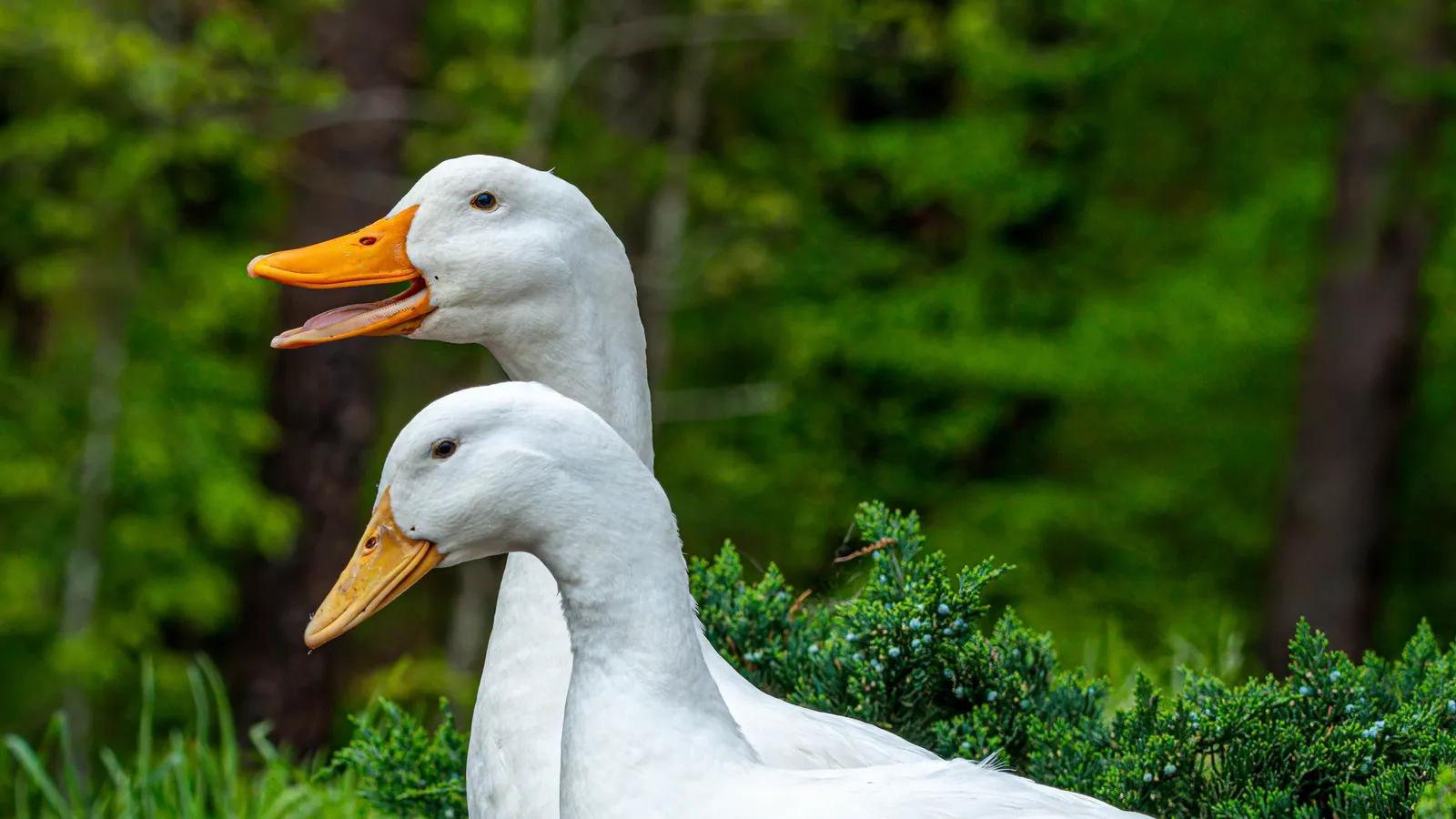
Two white Pekin ducks standing among green plants

Two white Pekin ducks standing among green plants (1 of 3) — Irish Heart Photography, Pexels, Pexels License

Facts at a glance

Ranges, not exact numbers. sources differ means our sources disagree; typical means consistent keeper and hatchery reports rather than a measured standard. A dash means we have no sourced value yet.

Basics
Origin
Where it was developed

The country or region where the breed was first developed. Some breeds are named after a place that is not where they actually came from.

China[1][2]
Purpose
What it was bred for

The job the breed was developed for: eggs, meat, both, or looks. Any duck can be a pet, but this tells you what its body and habits are built around, such as how many eggs to expect or how big it grows.

Eggs and meat[2][3]
Bred for meat first; both sources also call it a general-purpose or multi-purpose duck.
APA class
Size class in the show standard

The American Poultry Association sorts the breeds it recognises into heavy, medium, light and bantam (miniature) classes by body size. It is a quick size shorthand, and matters most if you want to show ducks.

Heavy[1]
Livestock Conservancy status
How rare it is in the US

The Livestock Conservancy tracks heritage breeds that are becoming rare. Critical, Threatened and Watch mean progressively more birds. Recovering means it used to be listed and is doing better. "Not listed" only means it is not on their list, not that anything is wrong with it.

Not listed[4]
Not on the 2026 priority list. That is absence from the list, not a health rating.
Size
Weight, hen
Adult female weight

Typical weight of a grown hen. Hens are the females, the ones that lay eggs. Hatchery birds can be heavier or lighter than the show standard, so treat this as a guide.

8–9 lb (3.63–4.08 kg)[3]
8-9 lb in the extension table. Metzer's own breeders during lay run 8-12.25 lb across both sexes, and its Jumbo strain 9-13.5 lb, so hatchery birds can be heavier than this.
Weight, drake
Adult male weight

Typical weight of a grown drake. Drakes are the males; in most breeds they have a curled feather on the tail. They are usually heavier than hens.

9–10 lb (4.08–4.54 kg)[3]
9-10 lb in the extension table; Jumbo-strain hatchery stock can run well above that.
Temperament
Temperament
Calm or jumpy

Whether the breed tends to be calm and friendly or skittish and quick to startle. Individual ducks vary a lot and how they are raised matters, so this is a tendency, not a promise.

Calm[1][2]typical
Metzer's blog table says Calm, but on its 1 (very calm) to 9 (more nervous) scale it scores Pekins 5.5, the middle.
Flight
Can it fly away?

Whether the breed can get off the ground. Flightless breeds stay in behind an ordinary fence. Strong fliers may need a covered run or wing clipping.

Can't fly[1][2]
Broodiness
Likes to sit on eggs

A broody duck sits on her eggs to hatch them, then raises the ducklings. Highly broody breeds will hatch eggs for you. Breeds that rarely go broody lay more, but you need an incubator or another duck to hatch their eggs.

Rarely[1]typical
Metzer rates Pekin mothering Poor.
Foraging
Finds its own food

How actively the breed hunts bugs, slugs and greens on its own. Good foragers can cut garden pests but still need proper feed.

Medium[1]typical
Rated Fair.
Eggs
Eggs per year
Eggs per hen per year

Typical yearly laying for a hen. Numbers vary widely by strain (show lines lay far fewer than farm lines), by season, and by whether lights are used in winter.

100–200[1][2][3]sources differ
Kentucky Extension's table says 100-180, its text says about 200. Metzer says 150-200 for its Grimaud Hybrid Pekin and 140-175 for its Jumbo; the top of Metzer's range assumes 17 hours of artificial light.
Egg colour
Shell colour

Duck eggs are most often white, but some breeds lay pale blue-green, grey or even dark-tinted shells.

White[1][3]typical
Metzer reports under 2% bluish eggs.

Quick answers

How big do Pekin ducks get?
Hens weigh about 8–9 lb (3.63–4.08 kg); drakes about 9–10 lb (4.08–4.54 kg).
How many eggs do Pekin ducks lay?
100–200 eggs a hen per year. Our sources disagree; see the notes in the facts table.
Can Pekin ducks fly?
Can't fly.
Our take · our opinion, not sourced

Often a good fit for: first-time keepers, steady egg laying, a calm everyday flock.

Where the Pekin comes from

Records of the Pekin go back to China in the 1300s, and the breed reached Great Britain and then the United States in the 1870s [2]. It is now the main commercial meat duck in the US: Kentucky Extension puts about 90 percent of American duck meat down to Pekins [3]. That history matters if you are buying one as a pet, because most Pekins on sale come from meat-duck lines.

Size

Pekins sit in the American Poultry Association's heavy class [1]. The extension table gives hens as 8 to 9 pounds and drakes as 9 to 10 [3]. Hatchery stock can run bigger. Metzer weighs its own breeders during lay and lists its Pekin at 8 to 12¼ pounds, and its Jumbo Pekin at 9 to 13½ [1]. If a listing says "Jumbo", expect a larger bird than the standard. They are also flightless, which makes fencing simpler than it is for flighty breeds [1].

Eggs

Sources disagree here, so we give a wide range. Kentucky Extension lists 100 to 180 eggs a year in its table and about 200 white eggs in the text [3]. Metzer gives 150 to 200 for its standard Pekin and 140 to 175 for the Jumbo, and notes the top of each range assumes 17 hours of light during lay [1]. Pekins were bred for meat, but both sources treat them as a decent layer as well [2].

Temperament and mothering

Metzer's blog table calls the Pekin calm [2], though its own numeric scale puts the breed in the middle between very calm and nervous [1]. We would call it an easygoing duck, not a placid one. Metzer rates Pekin mothering as poor, so do not count on a hen to hatch and raise her own ducklings [1]. Foraging is rated only fair, below Runners and Muscovies, so a Pekin will eat what you provide more than it hunts for itself [1].

Names and strains

"Pekin" is not one standard bird in the hatchery trade. Metzer sells the same duck under two names, Pekin and Grimaud Hybrid Pekin, and says the "hybrid" is a cross between two strains of Pekin [2]. It lists a separate Jumbo Pekin, and rates both strains "meat class only" or "good for meat classes" for showing [1]. When comparing weights or egg counts from different sellers, check which strain they mean.

What we have not pinned down yet

We have no source we trust for how loud Pekins are or how long they live, and nothing on how they handle heat and cold, so those rows are blank rather than guessed. The Livestock Conservancy's 2026 priority list does not include the Pekin [4].

Read the full guide to keeping Pekins →Compare with:CallCayugaCrestedIndian Runner

Other breed guides: Call, Cayuga, Crested, Indian Runner, Khaki Campbell, Muscovy, Rouen.

Still choosing? See our roundup of the best duck breeds for a pet, and line up an avian or exotic vet before your ducks arrive.

References

  1. [1]Metzer Farms (hatchery), Compare Duck Breeds. Accessed 2026-10-20.
    A hatchery's own table. Weights are Metzer's breeders during lay. Temperament scale: 1.0 very calm to 9.0 more nervous. Pekin appears only as Grimaud Hybrid and Jumbo; Runners are listed by colour, not as one row. Egg numbers: lower figure assumes no artificial light, upper assumes 17 hours of light. Its 'conservation status' column is Metzer's own, not the Livestock Conservancy's.
  2. [2]Metzer Farms (hatchery), Pekin Ducks (2018). Accessed 2026-10-20.
    Blog post dated 2018-02-23. Silent on noise, lifespan and climate. Does not discuss Jumbo, American or German strains.
  3. [3]University of Kentucky Cooperative Extension Service (Jacquie Jacob and Tony Pescatore), Selecting Ducks (ASC-198). Accessed 2026-10-20.
    Undated. Its Table 1 covers 14 breeds and omits Ancona, Silver Appleyard, Welsh Harlequin and Saxony. Table and text disagree in places (Pekin eggs 100-180 vs 'approximately 200'; Muscovy hen 6-7 lb vs 5-6 lb). Written for meat and egg selection, not pets.
  4. [4]The Livestock Conservancy, 2026 Conservation Priority Poultry Breeds (2026). Accessed 2026-10-20.
    Lists breeds at risk. A breed that is absent (Pekin, Muscovy, Call, Crested) is simply not on the list, not rated.